Replit AI Review 2026: Powerful AI App Builder or Just Another Coding Assistant?
If you want to turn an idea into a working application without spending hours configuring a development environment, Replit AI deserves serious attention in 2026.
Replit has evolved far beyond its original role as a browser-based coding environment. Its AI-powered development tools are designed to help users move from an idea to a functional application through natural-language instructions.
That makes Replit different from traditional AI coding assistants that mainly suggest or generate code.
The bigger question is whether Replit AI can actually replace developers.
The answer is no. But it can significantly accelerate prototyping, MVP development, internal tools, web applications, and many small-to-medium software projects.
What Is Replit AI?
Replit AI is the collection of AI-powered development capabilities integrated into the Replit platform.
The main idea is simple: instead of manually creating every component of an application, users can describe what they want to build using natural language.
For example, you could ask Replit to:
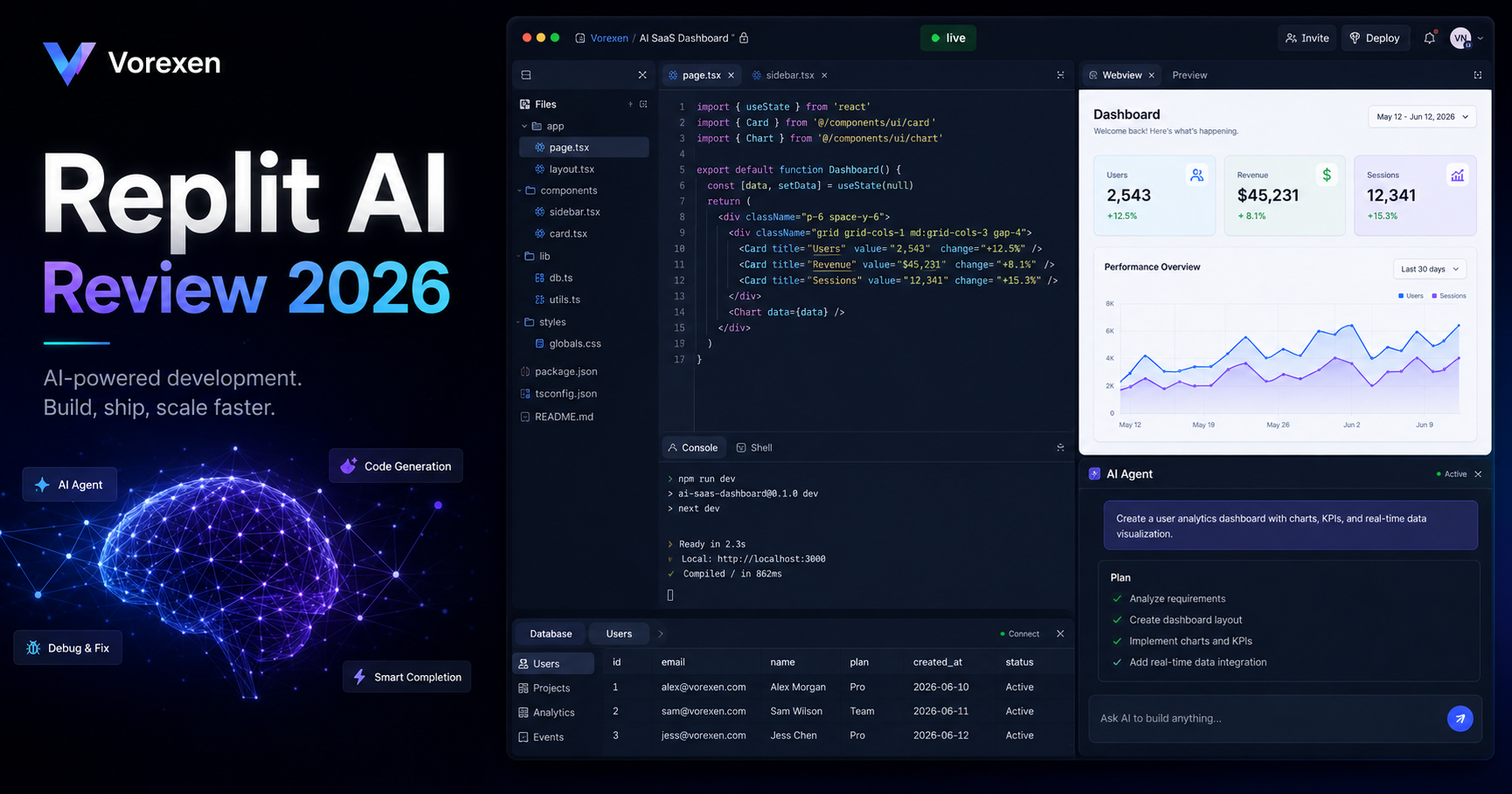
Build a SaaS dashboard for managing freelance projects with authentication, projects, tasks, invoices, search, and analytics.
The AI can then help create the application structure, generate code, configure functionality, and iterate on the project based on additional instructions.
This makes Replit particularly interesting for users who want to reduce the time between an idea and a working prototype.
What Is Replit Agent?
Replit Agent is the AI-driven development system at the center of Replit’s current AI strategy.
Rather than simply completing individual lines of code, an AI agent can work across multiple parts of an application.
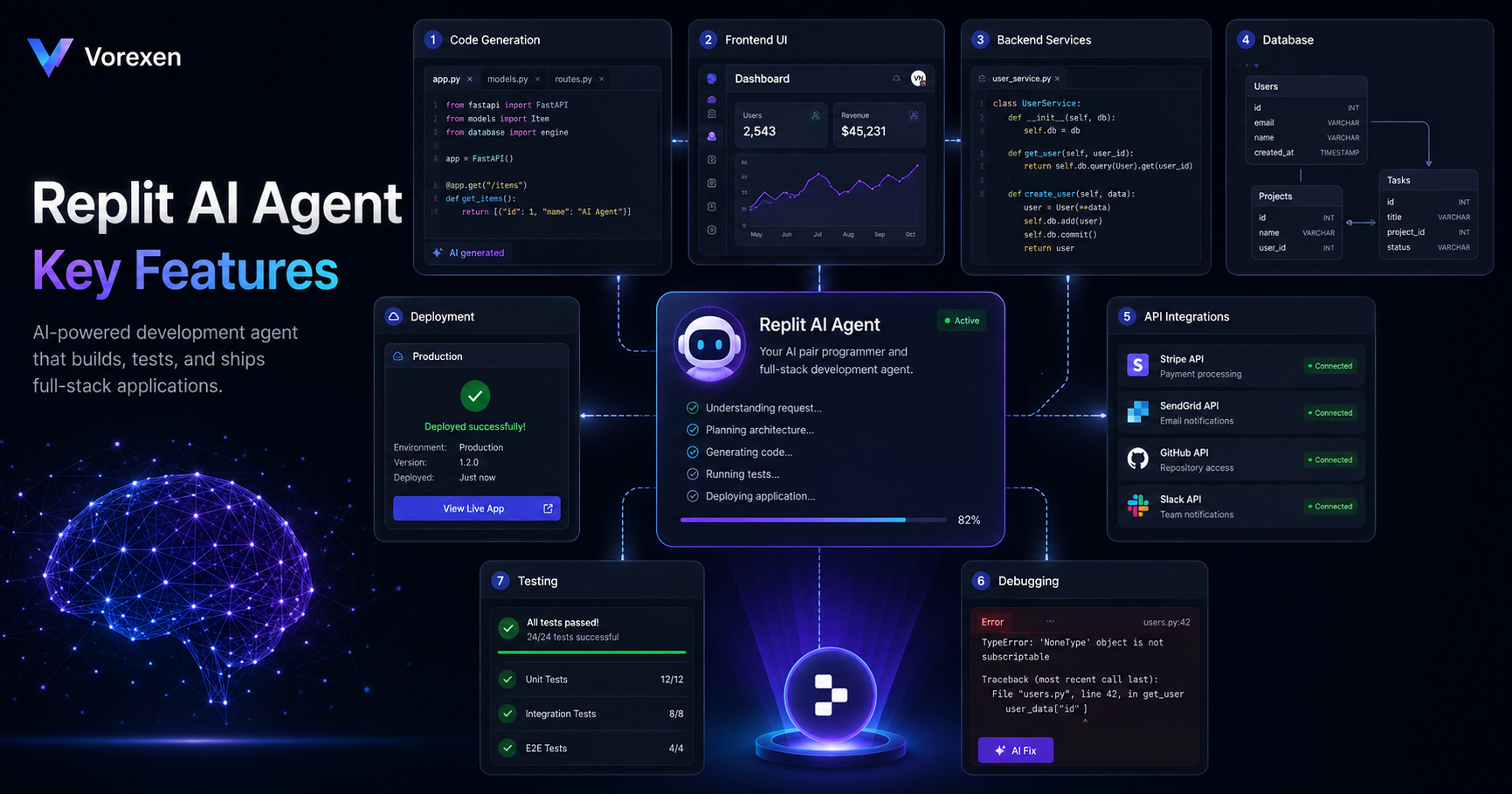
Depending on the project, this can involve:
- Planning an application
- Creating project files
- Writing frontend code
- Writing backend code
- Working with databases
- Implementing authentication
- Testing functionality
- Finding bugs
- Making requested changes
- Preparing applications for deployment
How Replit AI Works
1. Describe Your Application
The process starts with a natural-language description.
Instead of manually creating a project from scratch, you can explain the product you want to build.
2. Let the Agent Create the Initial Version
The Agent analyzes your requirements and begins constructing the application.
It can create files, components, application logic, and other required elements.
3. Run and Inspect the Application
You can run the application and evaluate the generated result.
4. Request Changes
You can continue the conversation with instructions such as:
Make the dashboard responsive on mobile devices and add dark mode.
Or:
Add pagination, sorting, and filtering to the customer table.
5. Test and Iterate
The development process becomes iterative rather than requiring everything to be completed manually before testing.
Key Replit AI Features
Natural-Language Development
The ability to describe software requirements in ordinary language is one of Replit AI’s biggest advantages.
This makes the platform accessible to:
- Developers
- Startup founders
- Students
- Designers
- Product managers
- Content creators
Full-Stack Application Development
Replit is designed for more than frontend code generation.
A project can include:
- Frontend interfaces
- Backend services
- Databases
- Authentication
- API integrations
- Application logic
- Deployment
This integrated environment is especially useful when building prototypes and MVPs.
Database Integration
Applications frequently require persistent data.
Instead of manually configuring every part of a database workflow, users can describe the required data structure and ask the AI to implement it.
For example:
Create database models for users, projects, tasks, invoices, and payments.
The Agent can then help implement the required application logic.
Authentication
User authentication is essential for many modern applications.
Depending on the project, Replit can help implement functionality such as:
- User registration
- Login
- Protected pages
- User-specific data
- Account management
API and Service Integrations
Modern applications often depend on external APIs and services.
Replit projects can integrate with external platforms for functionality such as:
- Payments
- AI APIs
- Communication
- Analytics
- Data processing
- Productivity services
Testing and Debugging
Generating code is only part of software development.
Replit AI can assist with identifying problems and making corrections during the development process.
However, AI-generated code should always be reviewed and tested by a human before production use.
Replit AI Use Cases
Rapid MVP Development
MVP development is one of the strongest use cases for Replit AI.
A founder can create an initial product, test the concept with users, collect feedback, and iterate without immediately building a large engineering team.
Internal Business Tools
Companies can use AI-assisted development to create:
- Dashboards
- Reporting systems
- Employee portals
- Data management tools
- Automation interfaces
- Internal applications
SaaS Prototypes
Replit AI is particularly useful when testing SaaS concepts.
You can begin with a simple version and gradually add authentication, databases, billing, analytics, notifications, and team features.
Learning Programming
Students can use Replit AI as an interactive programming assistant.
For example, you can ask the AI to explain a function, identify a bug, or demonstrate how an API works.
The best approach is to use AI to accelerate learning, not to completely avoid understanding the underlying technology.
Replit AI for Developers
Experienced developers can use Replit AI as a productivity multiplier rather than a replacement for engineering expertise.
It can help accelerate:
- Boilerplate development
- Prototyping
- Debugging
- Refactoring
- Testing
- Documentation
- API integration
- UI development
The developer remains responsible for architecture, security, performance, maintainability, and technical decisions.
Replit AI vs Other AI Coding Tools
Replit is part of a rapidly expanding category of AI-powered development platforms. Developers evaluating alternatives may also want to compare it with Cursor AI and Windsurf.
For developers looking at AI coding assistants, Codeium provides another interesting alternative, while enterprise-focused teams may also consider Tabnine AI Enterprise.
Organizations working with AWS-oriented development workflows can also evaluate Amazon Q Developer.
Replit AI for Non-Developers
Replit AI lowers the initial barrier to software development.
A founder or creator who understands a business problem but has limited programming experience can potentially create a functional prototype through natural-language instructions.
However, the more complex the application becomes, the more valuable technical knowledge becomes.
Important skills still include:
- Requirements analysis
- Product thinking
- Testing
- Security awareness
- Prompt design
- Understanding application architecture
Replit AI Pros and Cons
Pros
- Fast development: Quickly turns ideas into prototypes.
- Integrated environment: Development and deployment are closely connected.
- Excellent for MVPs: Useful for validating product concepts.
- Natural-language workflow: Users can communicate requirements conversationally.
- Full-stack capabilities: Supports more than simple code completion.
- AI agents: Automates multiple stages of the development workflow.
Cons
- Generated bugs: AI-generated code can contain unexpected problems.
- Security concerns: Sensitive functionality requires human review.
- Limited architectural control: AI-driven workflows may not suit every development style.
- Usage costs: Heavy AI usage can increase expenses.
- Platform dependency: Projects can become dependent on platform-specific services.
Replit AI Pricing 2026
Replit uses a combination of subscription plans and usage-based AI resources.
| Plan | Price | Best For |
|---|---|---|
| Starter | Free | Experimentation |
| Core | $20/month when billed annually | Individual builders |
| Pro | $95/month when billed annually | Professional users |
| Enterprise | Custom | Organizations |
Pricing and included AI usage can change, so users should verify the current plan details before subscribing.
Replit AI vs GitHub Copilot
GitHub Copilot is primarily an AI coding assistant integrated into existing developer workflows.
Replit Agent is designed around a more autonomous development workflow.
In simplified terms:
GitHub Copilot: AI coding assistance.
Replit Agent: AI-assisted application development.
Developers who already have a sophisticated local development environment may prefer an IDE-centered assistant, while users who want an integrated cloud development experience may find Replit more convenient.
How to Get Better Results from Replit AI
The quality of your instructions strongly affects the quality of the generated application.
A vague request such as:
Build me a website.
provides very little useful context.
A better request should specify:
- Target users
- Business objective
- Required features
- Data requirements
- UI requirements
- Authentication
- Testing requirements
- Deployment expectations
For example:
Build a responsive SaaS dashboard for freelance project management. Include user authentication, projects, tasks, invoices, search, filtering, analytics, a relational database, responsive design, accessible components, sample data, and tests for the main user flows.
Best Replit AI Workflow
Step 1: Define the Product
Explain what the product does and who will use it.
Step 2: Define the MVP
Start with essential functionality rather than attempting to build everything at once.
Step 3: Establish the Architecture
Decide how the frontend, backend, database, authentication, and integrations should work together.
Step 4: Build Incrementally
Ask the Agent to implement features in manageable stages.
Step 5: Test Continuously
Test each major feature before adding another one.
Step 6: Review Security
Pay particular attention to authentication, authorization, API keys, input validation, and sensitive data.
Step 7: Optimize
Review performance and code quality before production deployment.
Step 8: Deploy
Deploy only after the application has been sufficiently tested.
Can Replit AI Replace Developers?
Not completely.
AI can automate substantial portions of software development, but professional software engineering includes much more than writing code.
Developers remain responsible for:
- Architecture
- Security
- Scalability
- Testing
- Performance
- Code review
- Maintenance
- Technical decision-making
The more realistic future is not developers versus AI.
It is developers working with AI agents.
Who Should Use Replit AI?
- MVP development: ⭐⭐⭐⭐⭐
- Rapid prototyping: ⭐⭐⭐⭐⭐
- Web applications: ⭐⭐⭐⭐⭐
- Internal tools: ⭐⭐⭐⭐⭐
- Learning: ⭐⭐⭐⭐☆
- Small SaaS projects: ⭐⭐⭐⭐⭐
- Professional development: ⭐⭐⭐⭐☆
- Large enterprise systems: ⭐⭐⭐☆☆
- Mission-critical software: ⭐⭐☆☆☆
Try Replit AI
If you want to experiment with AI-powered application development, Replit is worth exploring. Its AI-assisted workflow can help turn an idea into a working prototype without requiring you to configure an entire development stack manually.
It can be particularly useful for developers, startup founders, students, and creators who want to experiment with rapid application development.
Ready to explore Replit AI?
Try Replit AIDisclosure: This section may contain an affiliate link. If you purchase a paid plan through our link, Vorexen may earn a commission at no additional cost to you.
Replit AI Final Verdict
Replit AI has moved well beyond the traditional concept of an AI code completion tool.
Its biggest advantage is the combination of an AI agent with an integrated software development environment.
The overall workflow brings together:
AI Agent + Development Environment + Database + Integrations + Testing + Deployment
This makes Replit particularly compelling for users who want to move quickly from an idea to working software.
Developers can use it as a productivity multiplier, startups can use it to accelerate MVP development, and non-developers can use it to lower the initial barrier to software creation.
However, AI-generated applications still require human supervision.
Our verdict: Replit AI is a powerful AI development platform, but it works best when human expertise remains part of the development process.
Vorexen Rating: 9.0/10
Best for: AI-assisted development, MVPs, prototypes, web applications, internal tools, and rapid product experimentation.
Bottom line: Replit AI is one of the most interesting AI-powered development platforms for users who want to combine natural-language programming with an integrated development environment.
FAQ
What is Replit AI?
Replit AI is the collection of AI-powered development features integrated into the Replit platform, including its AI Agent capabilities.
Is Replit AI free?
Replit offers a free Starter option for users who want to explore the platform.
Can Replit Agent build a complete application?
Replit Agent can help build substantial full-stack applications, but complex production systems still require human engineering, testing, and review.
Do I need programming experience to use Replit AI?
No. Beginners can start with natural-language instructions. However, technical knowledge becomes increasingly important as applications become more complex.
Is Replit AI good for MVP development?
Yes. Rapid MVP development is one of the strongest use cases for Replit AI.
Is Replit AI better than ChatGPT for coding?
Not necessarily. They have different strengths. Replit is an AI-powered development environment, while ChatGPT is a broader AI assistant for reasoning, research, coding, learning, and many other tasks.
Can Replit AI replace software developers?
No. It can automate many development tasks, but architecture, security, testing, scalability, and technical decision-making still require human expertise.